Doctor English
27 August 2021 15:24
Effect and Affect
If you find English a little confusing sometimes, there is something to make you more confused.
According to Sadhguru, these two words are the reason why people hate English.
If you can tell the difference between them right now before reading the rest of the post, I have some doubts whether you're a human.
For the rest of you, we need to talk.
Effect is a noun. Not a verb, a noun. It means a change.
For example: Smoking has a bad effect on your health.
Affect is a verb. Not a noun, a verb. It means to cause change on something.
For example: Smoking affects your health.
In short, affect is to have an effect on something. The goal here is not to understand their meaning. Both of them mean a change on something. The goal is to remember that one of them is a noun, the other one is a verb.
Читать полностью…
Doctor English
26 March 2021 18:18
Let's learn two phrases you can use when you have a guest at home so your visitors think you're a cool person even though you're not.
First one is make yourself at home.
So, when someone comes to your house, you can say make yourself at home. What you mean by this is your guest can feel comfortable as if they're in their own house.
Not so difficult, right?
Second is a little tricky one - help yourself.
Let's imagine you have a friend at your house and he says he is hungry. You can say "There is some pizza in the kitchen, help yourself."
But what do you mean when you say help yourself?
Well, when you say that there is some pizza in the kitchen, help yourself, what you're actually saying is that there is pizza in the kitchen and you can eat as much as you want aaand you don't have to ask for my permission.
Let's take another example. So, you're having a party, your friends are sitting around the table, the table is full of food, snacks, drinks.
You could say 'Hey, help yourselves' so that they can eat whatever they want, as much as they want.
Okay, this is it for today. Now, help yourself :)
Читать полностью…
Doctor English
01 June 2020 08:46
What do you say to some phrase and words related to romance?
Okay, I hear you. Let's go.
If you check someone out, it means you look at someone because you find them attractive or interesting.
ex: There was a girl at the party sitting alone, I couldn't help checking her out.
player - this word is usually used for boys, sorry guys, a player is a boy who likes to chat up girls.
ex: He was a rich guy and a little bit of a player.
go on a date - to meet someone who you are romantically interested in. You can hear that idiom a lot in movies.
ex: I started using Tinder and going on lots of dates.
single - if you are single, you don't have a boyfriend or girlfriend. Sorry.
ex: If she's single, I am going to ask her out tonight.
chemistry - if there is a chemistry between two people, they like each other and are interested in each other
ex: It was obvious that there was a real chemistry between me and Hermiona.
to flirt - if you flirt with someone, you talk to them in a way that shows you are attracted to them and maybe want to have a relationship.
ex: I don't like flirting with girls but :))
There you go, you learned something new today, good. Advice from me, if you like someone, go talk to them. If they're not interested, leave it there. Now, close your eyes and listen to this song.
@
Читать полностью…
Doctor English
05 May 2020 08:30
Hey, what's up. You are a talented learner!
Just kidding. I lied. In fact, I just told you a white lie.
And now that you don't know what it means, we're going to learn and master it. Before we begin, I am not racist, okay? It's a language.
So, a white lie is a lie that you tell in order to avoid hurting someone's feelings or to protect them.
In other words, it's a lie with good intentions. Here are some examples with the word white lie and some demonstrating them:
- Hey, how do I look in this dress?
- You look great!
- I danced okay yesterday, right?
- Totally
- What's the harm of a white lie if it will make her feel better?
- Why hadn't she told a white lie and claimed she had a licence?
- I love you
- I love you too
Have a good day. @
Читать полностью…
Doctor English
24 December 2019 13:42
Today we're going to make your vocabulary longer without any medicine. Now, I'll tell you about 3 synonyms of the verb to want, take a sit.
to fancy - in many cases its meaning is "to like" but in some cases "to want". You'll get the meaning from the context.
ex: Sorry, I don't fancy going out tonight.
ex: Sorry, I don't fancy making out tonight.
to desire - to want something very much. Its meaning is stronger than the verb to want.
ex: He desire to kiss her again..
ex: He desired to talk to her again..
to long to do something - to want to do something very much. It's similar to the verb desire but when you long to do something, it seems unlikely to happen soon..
ex: He longed to see her again..
ex: He longed to be with her..
F@ck. That he is me. Drama. @
Читать полностью…
Doctor English
30 November 2019 03:04
The first and the last post without sarcasm.
As soon as you go abroad to study or to travel, you start to feel that your English doesn't sound natural. (unless you're in India) (ok, only one)
What I want to tell you is that if you want to speak correct English, you should learn collocations as much as you can. And of course the grammar. (I don't understand those who say that you don't have to learn the grammar, you have to)
So today we will study some collocations with the word attitude. Attitude is a very useful word. Its exact meaning is an opinion, feeling or behaviour about something.
Now I'm going to tell you some collocations, expressions that you'll likely to hear.
someone has an attitude - if you say someone has an attitude, you mean that they don't seem to want to be polite or helpful.
ex: She has an attitude.
somebody’s attitude changes -if someone's attitude changes, their way of thinking, feeling, behaviour about something changes.
ex: As you get older, your attitude changes.
good/bad attitude
ex: a lazy student with a bad attitude (you?)
positive/negative attitude
ex: I have a very positive attitude to smoking.
public attitudes/people’s attitudes - opinion or feeling of people, public
ex: People's attitudes have changed
@
Читать полностью…
Doctor English
24 September 2019 05:00
Hey. Today's lesson will be classic, like Liszt's La Campanella.
We're gonna learn three fricking similar verbs and talk about their difference.
to advise - it's like you tell someone what they should do, especially when you know more than they do about something. If not, don't.
ex: The doctor advised me to quit smoking.
And a noun form of this verb is advice. It's a crap people give you that they think will help you, but doesn't really. Sometimes does, I don't know.
ex: Go to your elders for advice, not to Facebook.
to recommend - to advise someone to do something. Hmm, so it's the same as the verb to advise? No. Recommend is more personal and used when someone is giving a suggestion based on personal experience. (What?)
ex: I recommend (that) you listen to English podcasts.
to suggest - this verb is more informal and softer than to advise. You just tell your opinion about what they should do and it's their business to do or not to do so. You don't care.
ex: I suggest (that) you forget her.
Please, do not mess with the grammar.
to advise someone to do something
but to suggest someone do something
Doctor English
Читать полностью…
Doctor English
04 September 2019 12:17
100 influencers from all around the world got together in Uzbekistan some days ago. These are the pictures they took. They're cool.
Читать полностью…
Doctor English
10 August 2019 11:31
Hey! Today we talk about the difference between at the end and in the end.
at the end (of something) = at the time when something ends. You use at the end when talking about the last part of a story, book, concert, film, game etc.
ex: At the end of the concert, Ed Sheeran asked me to take a selfie with him.
You can also use at the end to talk about the last part of a period of time.
ex: We're going on holiday at the end of the month. (week, day, year etc)
in the end = finally
You use in the end when talking about the final result of a situation.
ex: He couldn't stop laughing. He got fired in the end.
ex: I had a lot of problems with my car.
I decided to sell it in the end.
Doctor English
Читать полностью…
Doctor English
06 August 2019 05:08
Hey! It's time to learn some serious shit.
Today we've the phrase would rather.
In general, would rather is used to say that you'd prefer to do something.
ex: I don't drink alcohol, it's bad for health. I'd rather smoke.
Pay some attention here, we don't use to after would rather. Just the verb itself.
ex: I'd rather get some sleep.
The negative form is "would rather not"
ex: I'd rather not watch Tv right now.
If you'd prefer someone to do something you say "I'd rather you did something"
Not "I'd rather you do"
ex: I'd rather you made the dinner.
ex: I'd rather you didn't drive.
We're using the past here (made, did), but don't worry, the meaning is present.
ex: I'd rather you made the dinner now.
I'd rather you read Doctor English.
Читать полностью…
Doctor English
28 July 2019 09:15
Tuzumila? Bugun ikkita dangasalarga xos bo'lgan kollokeyshnlarni o'rganasan.
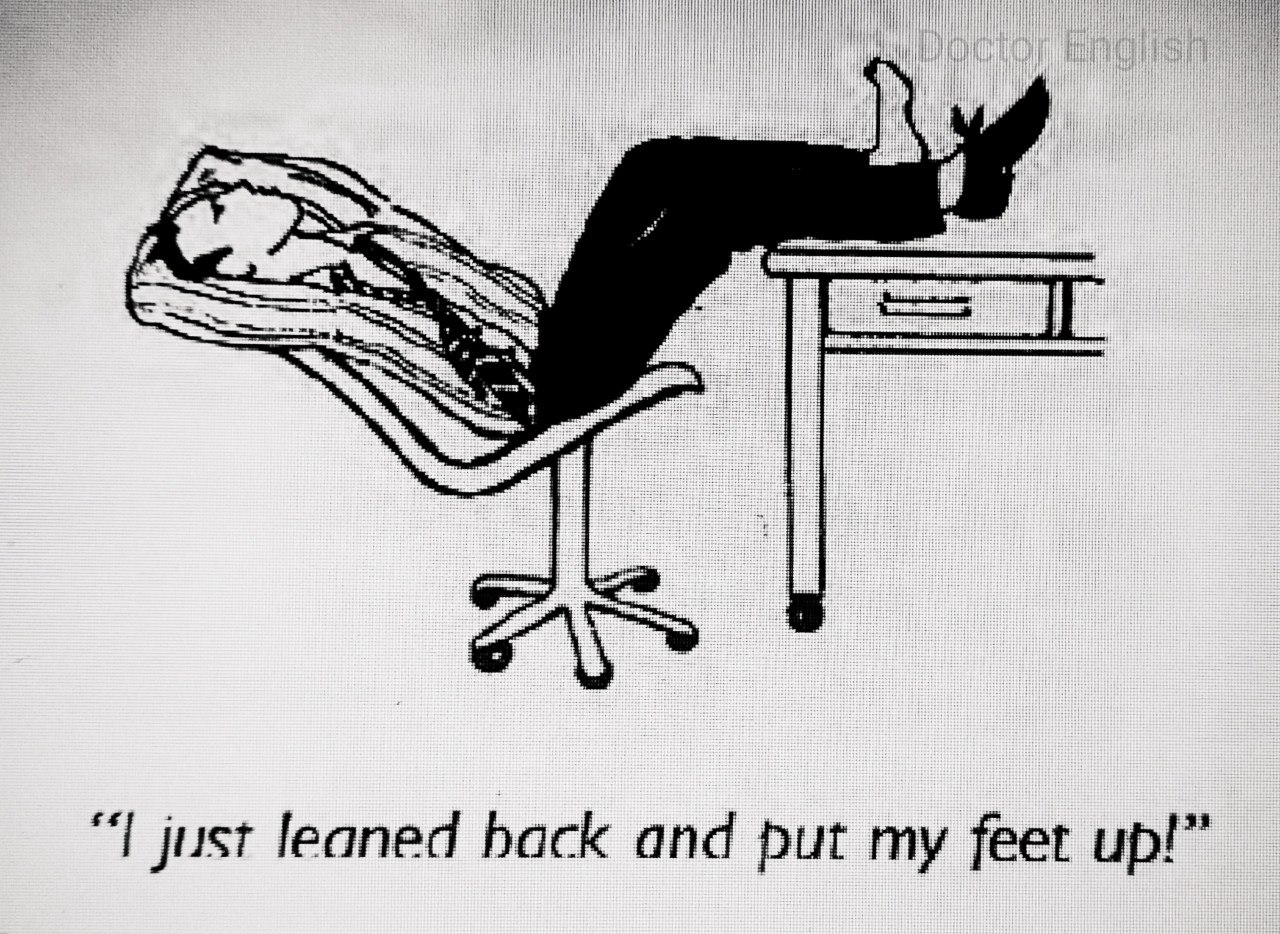
lean back in your chair - to sit with your back bent towards the back of a chair.
put your feet up on the desk - to sit with your feet on the desk.
For example yesterday I was sitting in my chair and suddenly remembered I got a lot to do: new words to learn, exam to prepare, homeworks, my football game etc... What did I do?
Читать полностью…
Doctor English
23 July 2019 10:07
I sat quietly on the exam yesterday.
I sat on the exam yesterday quietly.
Which sentence is correct?
First, know that: quietly, on the exam and yesterday are adverbials from the example sentence above. Adverbials are part of a sentence which give extra information to the rest of the sentence. But which adverbial comes first in sentences? Many people don't know that. So, always keep this order in mind: manner, place, time.
ex: I wrote that post quickly in bed last night.
manner (quickly), place (in bed), time (last night)
If there is no one of the adverbials, order is remained the same.
ex: I met a porn star in town yesterday.
place (in town), time (yesterday)
You can also put the time at the beginning.
ex: Last year I went to Parij.
Doctor English.
Читать полностью…
Doctor English
17 July 2019 16:17
Today we have a test for attention and one tricky word lack.
Look:
1. Lack of money makes me crazy.
2. You lack confidence.
In the first sentence lack is a noun.
Lack is another word for shortage or absence. But, important thing here is that lack is always used with the preposition of. Here is another example:
ex: Newly married couples suffer from lack of sleep :)
In the second, lack is a verb. If you lack something, you don't have it. But, boys, pay attention here. There is no preposition after the lack when it is a verb. Don't use in or of or any kind of preposition after this verb. Example:
They lack ideas. Not 'They lack of ideas'
However (damn it), you can use the preposition in after to be lacking in something. Meaning is still the same.
ex: We are lacking in ideas.
Girls seem to be lacking in intelligence these days. Do'xtir Inglish.
Читать полностью…
Doctor English
11 July 2019 03:30
This post is dedicated to the memory of some and any.
Always remember that some is used in positive sentences and any in negative sentences.
ex: I bought some flowers.
ex: I didn't buy any flowers.
You can use both some and any in questions. You use some/somebody/something to talk about a person or thing that you think exists:
ex: Are you in love somebody else?
(I think you are in love with somebody)
But in most questions, you use any. You don't know if the thing or person exists:
ex: Is there anybody in the house? (maybe there is, maybe not)
ex: Is anybody starting to freak out? (maybe, maybe not, you don't know)
Well, you can use any in positive sentences, too. Surprise. But when you use any in positive sentences, it means "it doesn't matter which"
ex: You can sit in any chair.
(it doesn't matter which chair)
ex: I can visit her any time I want.
ex: - Where should I go to have lunch?
- Anywhere. Just get the hell out of my office. Doctor English
Читать полностью…
Doctor English
05 July 2019 18:57
Someone ordered some grammar with despite and in spite of in it? It's been just delivered.
In spite of and despite. Both of them taste like although. Difference is after although you must use complete sentence (s+v), but after in spite of and despite you use noun/pronoun/ing.
Look: Although the traffic was bad, we arrived on time.
Now look at this: In spite of the traffic, we arrived on time.
Did you see what just happened my friend? We didn't write like "In spite of the traffic was bad...", because it is wrong. You don't use full sentence after in spite of and despite. Okay?
Some examples:
ex: We went out although it's raining./ We went out in spite of the rain.
ex: I couldn't sleep although I was really tired yesterday./ I couldn't sleep despite being really tired yesterday.
Enjoy your grammar. Doctor English.
Читать полностью…
Doctor English
31 March 2021 11:08
Why you shouldn't learn from "Ways to say ..." list or why you should learn the words with the context.
Let's say you come across a photo in instagram that has a title "Ways to say good luck". You start reading the phrases one by one: good luck, break a leg, blow them away, best of luck etc.
Now you want to sound cool and you use break a leg instead of good luck all the time. But if we learn more about the phrase break a leg, we can find that it means wishing good luck to people before a performance and not really used in daily life.
What about "Ways to say I don't like..."
dislike it, not fond of it, can't stand it, not my cup of tea and the list goes on. But these phrases don't really say I don't like something. Some of them has a meaning that says nah I don't really care or I really hate it. Let's take an example where one of these phrases would be inappropriate to use.
Imagine you're ordering a meal in a restaurant with your friend and your buddy orders a fried chicken. He asks you if you want the same meal. But you don't like fried chicken and want to order something else. You could say "nah I don't like chicken, I'll order something else". But you're genius and know lots of ways to say I don't like something. And you say "nah I can't stand fried chicken, I will order something else". While this is not a bad thing, it would mean that you really hate chicken and can't stand being around it. That would make your friend uncomfortable in a way because he may hesitate to eat chicken since you really hate it. If you said "I don't like it", it would mean "I don't like chicken but it's not a big deal."
What I am trying to say is that don't just remember the words or phrases, try to learn to use them in a correct way. I hope that was useful. See you next time.
Читать полностью…
Doctor English
28 December 2020 02:36
Hello, my friends. We learned about the verb to freak out before but I think it was a little short post. Today we are going deep into every meaning of freak out with examples. Let's go.
To freak out covers lots of emotional feelings in its meaning.
For example, to become anxious, upset, afraid, scared, surprised, excited, angry etc. Freak-outs happen just one day before the homework deadlines, when your dad says "we need to talk", when you break your mother's favourite plate, when your brother catch you while smoking, when you're walking around with your girlfriend and you see your wife, when you get your salary. So, it all depends on the context. We'll see them one by one with examples.
1) I started to freak out when my girlfriend said she's leaving the city.
In this example, freak out means to become anxious, to lose control, to lose nerve.
2) Daniel freaked out when he heard he's been hired by Google.
In this case, freak out means to become excited, surprised. (Oh my god!!!)
3) Mia was coming home from work. It was late and there was no one on the street. She freaked out when she heard footsteps right behind her.
She thought someone was following her.
This example gives another meaning of freak out: to become scared, afraid.
4) When my dad found out that I crashed his car, he freaked out.
In this case, freak out means to become angry and furious.
Don't freak out, it's not that difficult. Pay attention to the context to find the actual meaning.
Advice to avoid freak-outs: do your homework on time, don't smoke, be honest with your girl, don't steal your dad's car.
Читать полностью…
Doctor English
09 May 2020 07:23
Hey there. Today we're going to learn some common phrasal verbs we use while talking on the phone. Let's go.
call ... up - to call someone.
ex: I am going to call my girlfriend up when I find her.
call ... back - to return a call or to call again.
ex: I am busy right now, can I call you back later?
pick up - to answer the phone.
ex: - Did she answer the phone?
- No, nobody picked up.
hang up - to end a call.
ex: After I hang up, I realized that I had forgotten to get the address of the strip club.
hang up on ... - to end a call without waiting for the conversation to end.
ex: Don't hang up on me, you bit@h.
And, you probably know about hang on.
That's it for today.
See you. @
Читать полностью…
Doctor English
03 May 2020 10:26
Hey there. Long time no see. Again.
Sorry for postponing the posts, I like it.
Today's lesson is just a warm-up for next lessons.
Have you ever heard of policemen saying "roger that" or "copy that" in movies before? It just means "got it", "understood".
That's it. Have a good day. @
Читать полностью…
Doctor English
10 December 2019 12:40
Today we're about to talk about the phrase be about to do something and you're about to understand it very well.
So, when I say I am about to do something, I mean that I am going to do it very, very soon. I don't know when, but very soon.
For example, you have a party today with friends and one of your friends still hasn't come. You call him and he says "Bro, I'm just about to leave the house". That means he is leaving the house right now, maybe he is opening the door. (But actually he is in bed, still lying down)
Another example, so you're at school, you just finished your classes and you're going to go home now. But the hottest girl in your class asked you to stay with her and help her with the homework. And you say "You know what.. I am about to go home". (Your grammar is correct, but now you're the most stupid person in the world)
The most common mistake is this: "I am about to do it tomorrow" The word tomorrow. You don't include the specific time with be about to. When you say about to.. everyone understands you're doing it soon.
Give me your examples in the comments. Tell me something you're about to do.
@
Читать полностью…
Doctor English
08 October 2019 07:06
Hello, friends. Do you want to learn three collocations with the word promise? Okay, pull up a chair.
First, about the word promise. To promise is to tell someone that you'll definitely do something. It's mainly used by guys.(I'll always love you, I promise)
Okay, now, collocations:
to make a promise - to tell someone that you'll definitely do something
to keep a promise - to do what you promised to do
to break a promise - not do what you promised to do
Never forget that statement:
If you can't keep your promises, you shouldn't make them in the first place.
Of course, I won't forget to quote from Bruno Mars's song:
I will never make a promise that I can't keep, I promise that your smile ain't gon' never leave..
There is also a phrase (idiom, I don't know) I promise you, and it doesn't I promise you. (shock) It's used for emphasis, and if you want, you can translate it as trust me. (but not always)
ex: Your boyfriend thinks only about himself, I promise you.
Doctor English
Читать полностью…
Doctor English
04 September 2019 12:29
Today, we talk about the difference between house and home. I know most of you already know about it. So it's gonna be a brief information.
We use the noun house to talk about a building where people live.
ex: That’s my ex's house, on the left.
ex: My house has a red roof.
The word home is not used to talk about a building. It’s used in a more emotional way, to talk about the place where you live, the place you grew up etc.
ex: I can't wait to get home and rest.
ex: Home is where my laptop is.
For people, who still have no idea about the difference, this will help:
ex: I have moved into a new house, but it doesn’t feel like home yet.
Doctor English
Читать полностью…
Doctor English
27 August 2019 19:41
Yaxshi xabar. Bundan buyog'i postlarni o'zbek tilida yozib boraman. Inglizcha ham bo'ladi. Qanday bo'lishini xozir bilib olasan.
🇬🇧 To read this in English, click here.
Ana bilib olding. Endi, bugun to freak fe'li bilan bitta ikkita narsa o'rganamiz.
to freak out - havotirga tushish, qo'rqib ketish, to'satdan jahl chiqishi, hafa bo'lish, koroche, qanaqadir bir yomon narsa bo'lsa o'shanga qanday reaksiya bildirishingni tasavvur qil. masalan, sevgan qizing bilan mazza qilib aylanib yursang birdan ko'zing xotiningga tushib qoldi. Qayerlaringdir terlab ketadi, shokka tushasan ko'rib qolmasmikin degan havotirda.
ex: She freaked out when she saw the spider.
freaking - fucking so'zini aytishga beting chidamaganida ishlataverasan. ikkalasi bir xil. freaking muloyimroq eshitiladi.
ex: Get your freaking feet off of my tabel.
UPD: English is good.
@
Читать полностью…
Doctor English
06 August 2019 23:00
Hey. If you're standing, just sit down. Relax. Today it's gonna be an easy lesson. We're gonna learn three verbs with the preposition at. Let's do it!
to shout at - to yell at someone when you're angry. In my case, it's always.
ex: Don't shout at me, I'm doing my best!
to stare at - to look at someone or something directly for a long time without moving your eyes (remember the time when you see a hot girl?)
ex: Why the fuck are you staring at me?
to laugh at - to make the noise with your voice when you think something is funny. I know you know that one. Just remember to use it with at.
ex: Hey, I am not laughing at you. Lol.
Doctor English
Читать полностью…
Doctor English
30 July 2019 08:10
I went to hell and back while I was making that fucking picture yesterday.
I guess I should watch photoshop tutorials instead of po.. politics.
But, of course, we've got great lesson as usual. Today we'll learn the biography of during. In short, during, born in 1300, works as a preposition in sentences.
During can mean either throughout the whole time or at some point in a period of time. If you have a normal number of chromosomes, you'll understand the meaning from the context.
ex: We met some really nice people during our trip to zoo. (throughout the whole time of the trip)
ex: I fell off the chair during the class.
(at some point of the class)
Don't use verb or gerund after during.
No fucking excuse. Use while instead.
ex: They chatted while waiting for the bus. (Not during waiting for the bus)
Doctor English
Читать полностью…
Doctor English
26 July 2019 06:54
Hello. To remind you how time seems to pass very quickly, today we're gonna talk about the ways of saying the time.
9:00 - it's nine
9:05 - it's nine-oh-five
9:10 - it's nine-ten
9:10 - it's ten past nine
9:15 - it's nine-fifteen
9:15 - it's a quarter past nine
9:20 - it's nine-twenty
9:30 - it's nine-thirty
9:30 - it's half past nine
9:45 - it's nine-forty-five
9:45 - it's a quarter to ten
9:50 - it's nine-fifty
9:50 - it's ten to ten
12:00 - it's noon
12:00 - it's midnight
bonus for geniuses:
a.m. = time between midnight and midday: My work starts at 7 a.m.
p.m. = time between midday and midnight: My work finishes at 7 p.m.
Doctor English
Читать полностью…
Doctor English
21 July 2019 04:07
Hey. Don't get too emotional. You lived without her in the past, you will live as well. Today we talk about breakups.
to break/split up - to end a relationship
ex: We need to break up, it's not your fault.
to dump someone - to end a relationship
ex: My ex dumped me on my birthday.
to divorce - to end a marriage
ex: She divorced a year ago.
to separate - to stop living together
ex: They are still married, they just want to separate for a while.
Or you can just say I don't think we should see each other anymore and bam, now you're single.
Doctor English
Читать полностью…
Doctor English
14 July 2019 22:01
Imagine you are writing something
(an essay or a letter) You may be describing your new girlfriend to your friend. Like this: "she is blond and tall and cute and sophisticated.."
Or you're writing an essay about obesity. Like this: "overweight people tend to sleep a lot and they don't exercise
at all and eat way too much.."
Helllou, stopp. Do you have any other words to say instead of and? Frankly, your essay is the worst thing english learners have ever done. You keep writing and.. and.. and.. and.. and.. and.. and.. It's so boring.
Therefore, today you will learn how to add more information using different conjunctions. Conjunctions are: also, as well as, in addition to, besides etc.
Here are some examples, pay attention to conjunctions and how they are used:
Dr English is handsome and modest.
Dr English is handsome. He is also very modest. (also)
Dr English is handsome and very modest as well. (as well)
Dr English is handsome in addition to being modest. (in addition to)
Dr English is both handsome and modest. (both.. and..)
Dr English is not only handsome but also modest. (not only.. but also..)
Dr English is handsome. Besides, he is very modest. (besides)
Dr English is extremely handsome as well as modest. (as well as)
Great, thanks. I hope you write better letters next time you find a new girlfriend. Handsome Doctor English
Читать полностью…
Doctor English
08 July 2019 19:07
Hello, sorry for disappearing for a couple of days. I had a thing with a thing.
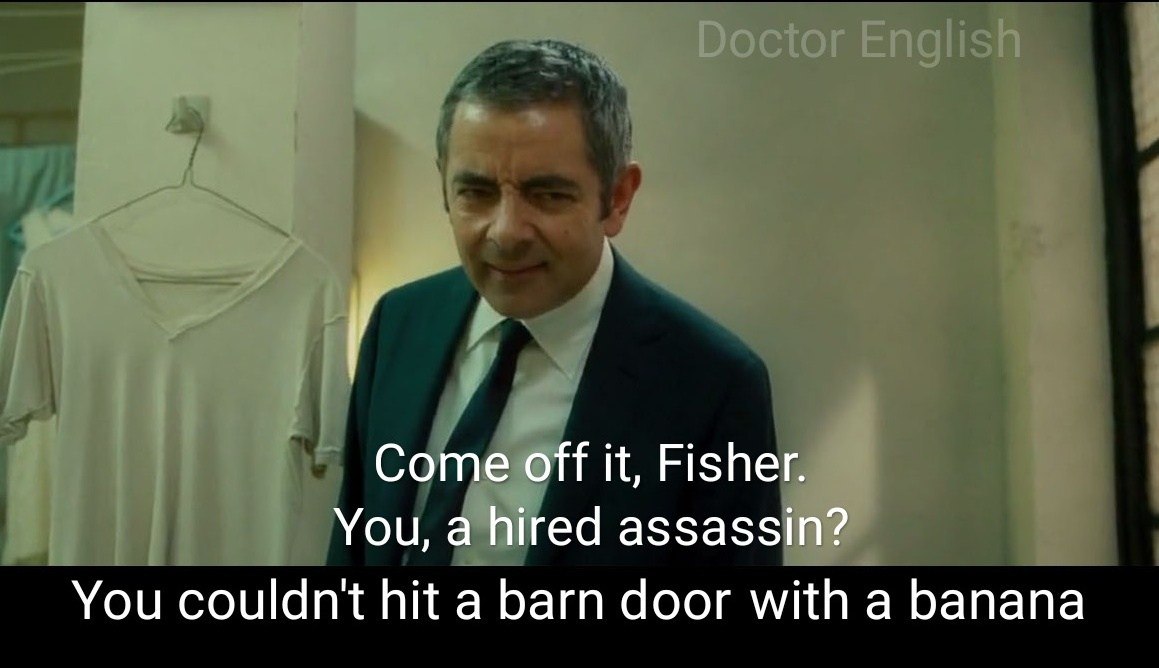
Today I got one interesting and useful idiom for you. As you can't guess, we're going to be talking about come off it.
come off it - you use it to tell someone to stop kidding, boasting or trying to make you believe in something. Whatever they say, you're not gonna believe them. You can also use it for telling someone that what they are saying is stupid.
For example, yesterday my friend was telling me that he met a cute, hot girl and got her phone number. I told him to come off it. Doctor English
Читать полностью…
Doctor English
03 July 2019 19:25
Hey. Today you'll learn some collocations connected with flying. On a plane, when the cabin attendant tell you to fasten your seatbelts it is more comfortable to fasten your seatbelts rather than be thrown out of your seat.
There is an adjective in-flight. When something is in-flight, it's provided during a plane journey. For example in-flight magazine is a magazine you will be provided for free during your journey.
ex: The in-flight magazine includes maps and information about major airports.
ex: They offer excellent in-flight entertainment, with the latest films and music.
board a plane is to get on a plane. In everyday English, people usually say get on a plane. Board a plane is formal.
ex: The passenger boarded the plane on time.
domestic flights are flights within your country, international flights are .. you know..
window seat is a seat next to window and a seat next to window seat is called aisle seat. At the airport someone might ask you if you prefer a window seat or aisle seat. Don't remember me with bad words if you confuse them and end up sitting different seat. Doctor English
Читать полностью…


 1034
1034